Quantum built on nature’s most perfect building block:
The atom.
IonQ’s trapped ion quantum systems are designed to solve challenges no classical computer can touch—from logistics and drug discovery to national defense.


IonQ’s trapped ion quantum systems are designed to solve challenges no classical computer can touch—from logistics and drug discovery to national defense.
.svg)
At its core, a quantum computer is a machine that uses a quantum system, like the spin of an electron, to do a very specific type of math.
This math takes advantage of the uniquely complex behavior of quantum systems, namely entanglement and superposition, to perform calculations that are fundamentally unlike the calculations ordinary computers based on classical physics can perform. Once quantum computers are powerful and stable enough, their unique computational power will solve world-changing problems that are beyond the capabilities of even the largest supercomputers.
Many quantum hardware developers use "synthetic" quantum systems for their quantum bits (qubits for short), like loops of supercooled superconducting wire, intentional imperfections in crystalline silicon, or other designs carefully coaxed to behave as quantum systems. At IonQ, we take a different approach. We use a naturally occurring quantum system: individual atoms.
These atoms are the heart of our quantum processing units. We trap them in 3D space, and then use lasers to do everything from initial preparation to final readout. It requires counterintuitive physics, precision optical and mechanical engineering, and fine-grained firmware control over a variety of components, but the superior results speak for themselves.
Read on to understand exactly how our trapped ion quantum cores work, and why they’re the most promising platform for quantum computing in development today.
Most quantum computers rely on superconducting circuits or exotic materials. IonQ takes a simpler, more powerful approach: we use single atoms—identical, stable, and natural—as the building blocks of computation.
.avif)
.png)
.avif)


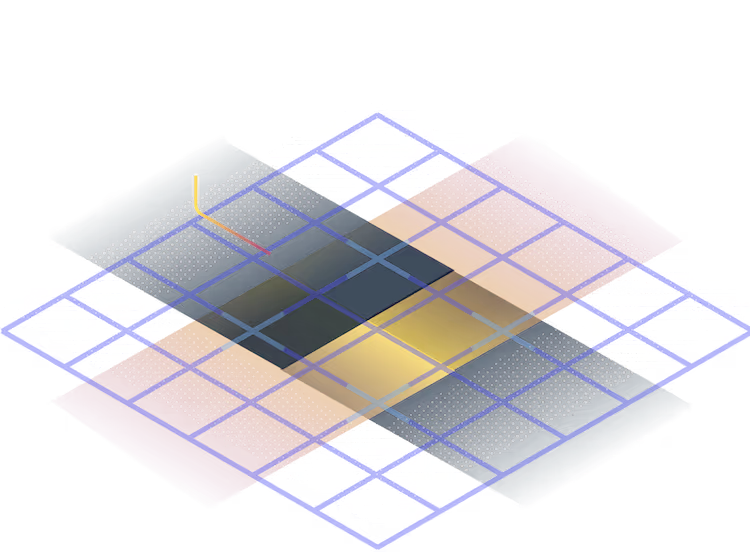




The most important part of any quantum computer are its quantum bits, or qubits. IonQ’s qubits are ionized ytterbium atoms, a silvery rare-earth metal. Each ytterbium atom is perfectly identical to every other ytterbium atom in the universe.
Moreover, once prepared in a particular stable quantum state, they can remain in that state for very long periods of time — they're so consistent they're used in one of the most accurate atomic clocks ever built.
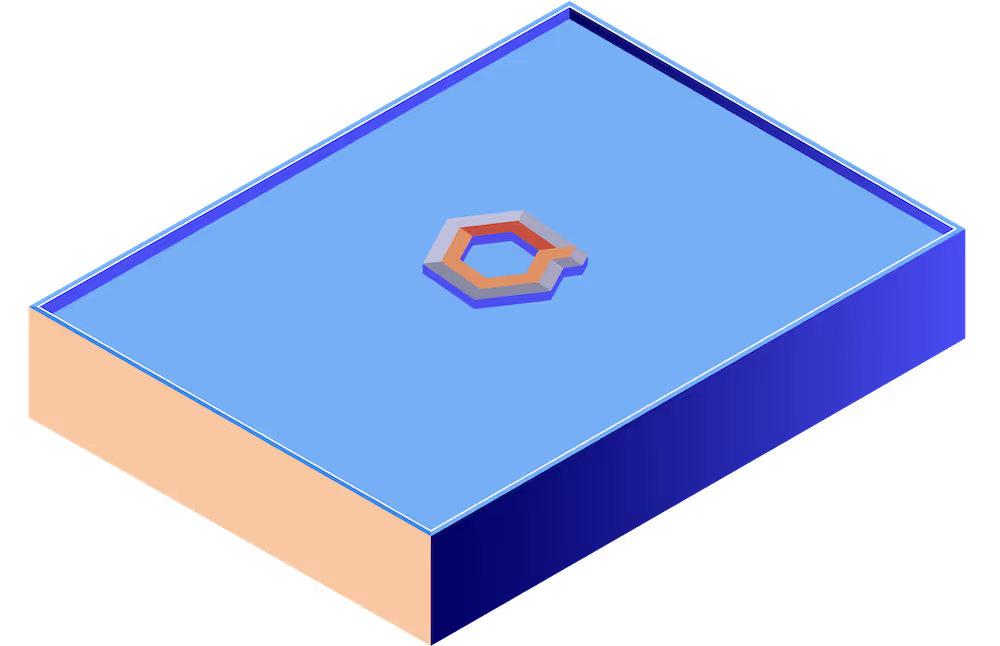
Once we've turned our atom into an ion, we use a specialized chip called a linear ion trap to hold it precisely in 3D space. This small trap features around 100 tiny electrodes precisely designed, lithographed, and controlled to produce electromagnetic forces that hold our ions in place, isolated from the environment to minimize environmental noise and decoherence.
We don’t stop at one ion; that wouldn’t make a very useful quantum processor. We can (and do!) load any number of ions into a linear chain.
This on-demand reconfigurability allows us to theoretically create anything from a one-qubit system to a 100+ qubit system without having to fabricate a new chip or change the underlying hardware. To date, we’ve run single-qubit gates on a 79 ion chain, and complex algorithms on chains of up to 35+ ions.
Before we can use our ions to perform quantum computations, we have to prepare them for the task. This has two major steps: cooling, which reduces computational noise and makes our ions better qubits, followed by state preparation, which initializes each ion into a well-defined “zero” state, ready to perform algorithms.
We compute using a series of operations called gates to manipulate the qubits’ state, first encoding and then operating on the information we want to calculate.
To perform these gates, we use an array of individual laser beams, each imaged onto an individual ion, plus one “global” beam. The interference between the two beams produces a beat note that is at exactly the necessary energy to kick the qubits into a different state.
Once the computation has been performed, reading the answer from the ions is done by shining a resonant laser on all of them at the same time. This process collapses any complex quantum information we’ve created and forces each qubit into one of two states.
Collecting and measuring this light allows us to simultaneously read the collapsed state of every ion — one of the states glows in response to the laser light, the other does not. We interpret this as a binary string, where each glowing atom is a one, and each dark atom is a zero.
To successfully hold complex quantum information, qubits can't interact with anything. A single stray hydrogen atom colliding with an ion can spoil the whole thing, collapsing delicate states, making ions switch places, or knocking the chain out of the trap entirely.
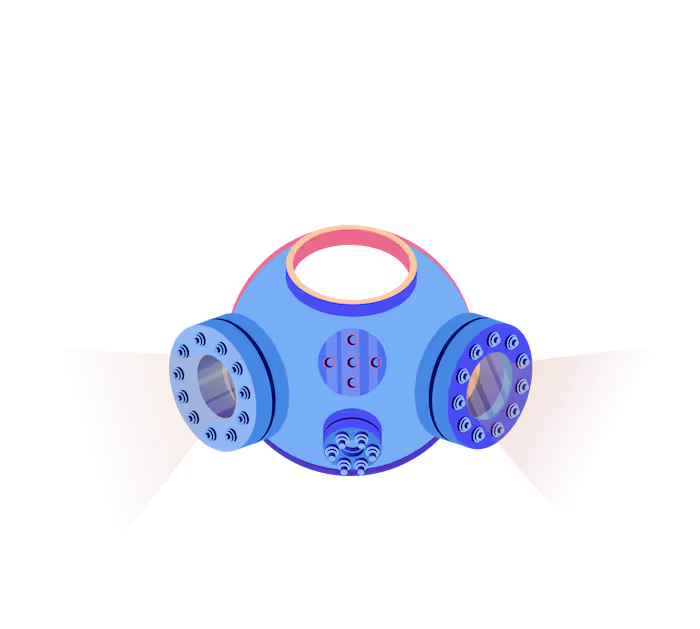
So, we put the trap inside an ultra-high vacuum chamber, pumped down to around 10-11 Torr. At this pressure, there are about one hundred trillion times fewer molecules per cubic inch than the air you're currently breathing.
Once everything's in the chamber, the whole assembly goes in an even larger enclosure with a variety of electrical, mechanical, and optical control systems.
Then, it all gets hooked to a classical computer running our custom control software, and after a great deal of calibration, it's a fully functioning quantum computer, ready to perform gates and run algorithms with world-leading fidelity.
.svg)
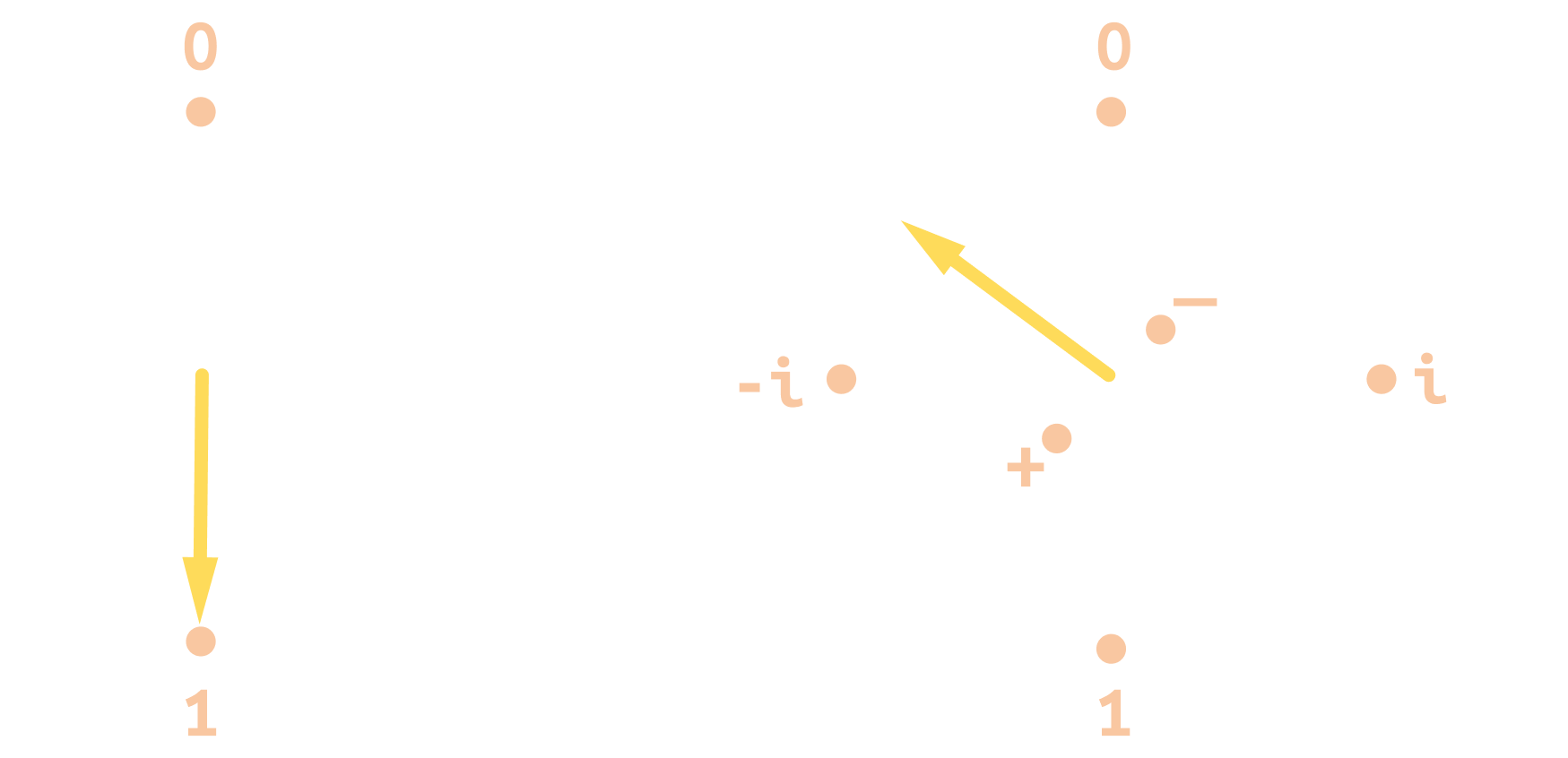
In a classical computer, the smallest unit of computation is called a bit. A bit can be in only one of two possible states: one or zero. A qubit has the ability to be in a complex superposition of these states, allowing for a much larger computational space — imagine only being able to point at the north or south pole, versus being able to point anywhere on the globe.
The only difference between a neutral ytterbium atom (Yb) and an ytterbium ion (Yb+) is one electron, which we remove with lasers as a part of the trapping process. This process, called ionization leaves the atom with a positive electrical charge and only one valence electron.
It’s impossible to create a trapping force with electrodes at fixed voltages that can hold an ion in a fixed position. Instead, we use rapidly oscillating voltages, such that the average field traps the ions in all three dimensions. As an analogy, imagine placing a ball on top of a saddle, and then spinning the saddle very quickly — it’s the same basic idea.
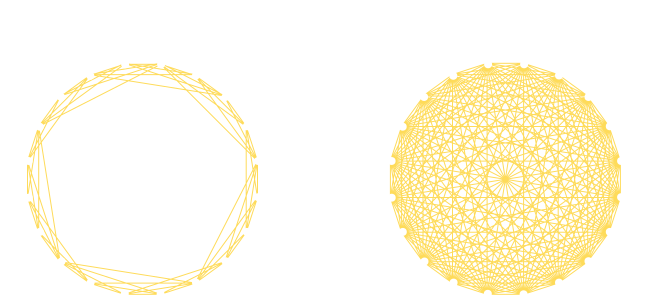
Another benefit of our on-demand qubit architecture is complete connectivity. Because our qubits aren't connected by physical wires, every qubit can interact with every other with no intermediary steps. This translates to a massive reduction in communication overhead, and by extension, computational noise.
Using Doppler Cooling, we can create qubits that are half of one one-thousandth of a degree above absolute zero, without needing to refrigerate any of the supporting hardware. This is extremely cold, but for optimal performance, we need to go colder, as close to absolute zero as we can. To accomplish this, we use a collection of laser-based techniques called resolved-sideband cooling to produce qubits so cold that they are almost perfectly still at an atomic level.
There are two basic types of gates in quantum computing: rotations, which modify an individual qubit’s state, and entangling gates, which link multiple qubits into an entangled state. Our native entangling gate is created by simultaneously 'plucking' two ions in on our chain with precise pulses of laser light.
This creates vibrations in the ion chain which are dependent on the qubit state. Since the amount that qubits interact depends on their distance from each other, these different vibrations result in an interaction between the two qubits that depends on the qubit state. At the end of the operation, the vibrations are gone, and the ions are left entangled.
Reading quantum information is challenging. If the qubit isn’t perfectly in its zero or one state when it’s observed, it probabilistically collapses into one of the two states, with a probability given by its actual state. The underlying state is destroyed in the process. This means that if we want to repeat a measurement, we can’t just measure again — we have to re-run the whole computation.
A useful way to think about vacuum pressure is the mean free path of an air molecule — the average distance it travels before hitting another air molecule. At room temperature and pressure, the mean free path of a given molecule is normally only a few nanometers, which corresponds to roughly a billion collisions per second. In ultra high vacuum, the mean free path is a few thousand kilometers, which means a collision should only occur once every 20 to 30 minutes. This allows for highly stable and long-lived chains.
Ion qubits have achieved the lowest gate error rate of any quantum technology.
.svg)
Reduced error rates mean fewer corrections and more reliable computations.

Every qubit can interact with every other directly.

Ions can remain in superposition far longer than other qubit types.
Our latest systems are built for performance and practicality, enabling partners to solve their largest and most complex real-world business problems.
See our industry-leading systems.avif)
Access our quantum systems on the cloud in as little as ten minutes, or contact our experts to discuss a custom partnership for your business.
Get started