The Birth of Quantum Computers: How Dr. Chris Monroe Ignited the Quantum Computing Revolution

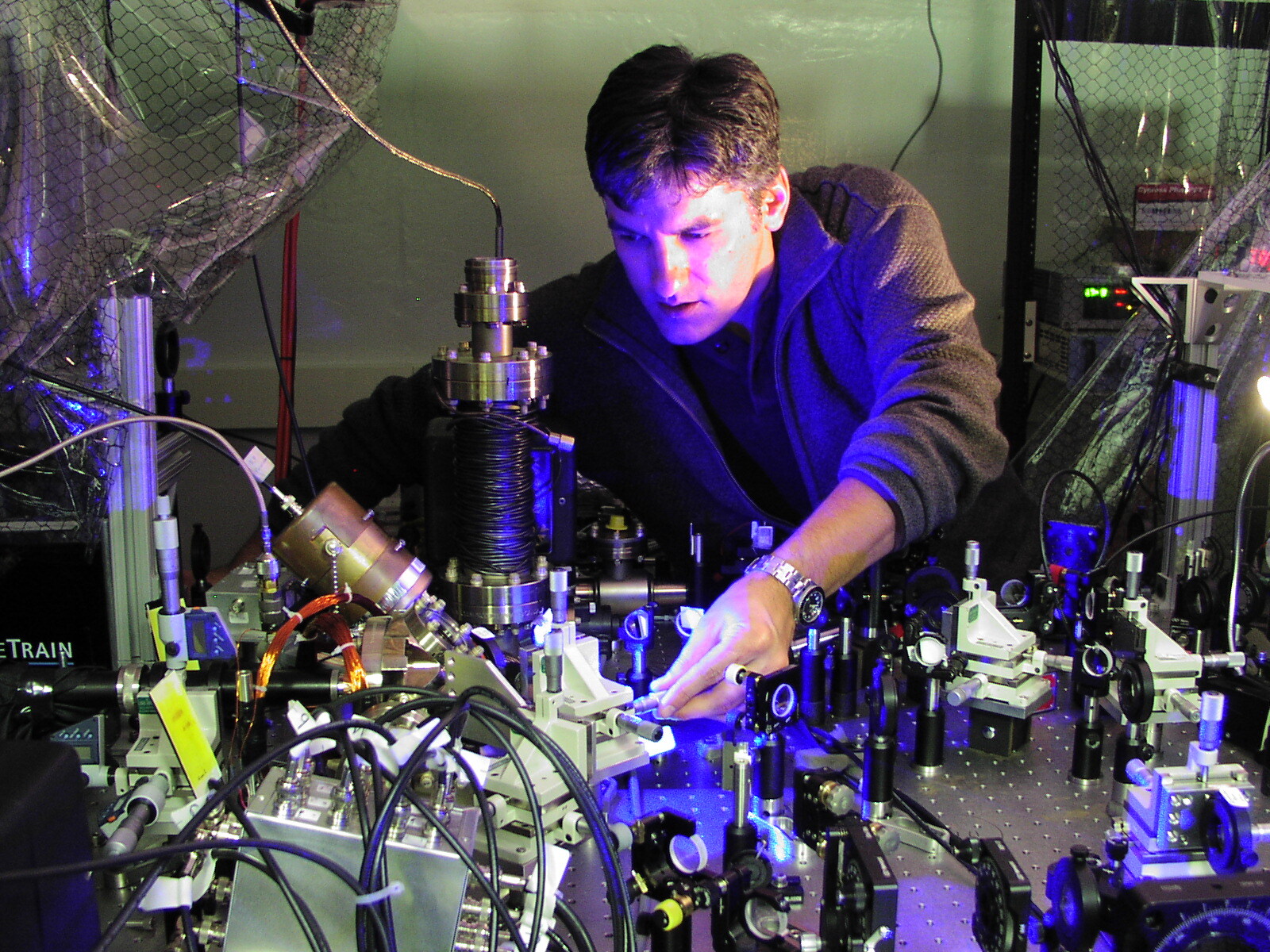
On December 18, 1995, a defining moment in the history of computing took place inside the U.S. atomic clock laboratories at the National Institute of Standards and Technology (NIST) in Boulder, Colorado.
That day, Dr. Chris Monroe, IonQ’s Co-Founder and Chief Scientist, published the first-ever experimental demonstration of a quantum logic gate on any physical platform, using trapped ions as qubits. The work was carried out in a research group led by Nobel Laureate Dr. David Wineland.
This achievement marked the practical birth of quantum computing. For the first time, quantum computation moved beyond theory and into reproducible, measured hardware. Thirty years later, the physics demonstrated in that laboratory experiment still defines what a real quantum computer is.
From Theory to Practice
For decades, quantum mechanics had existed primarily as a theoretical framework. Beginning in the 1920s, pioneers such as Heisenberg, Born, Jordan, and Schrödinger laid the foundations of modern quantum mechanics, introducing concepts such as wave mechanics and the uncertainty principle. In the 1980s, researchers including Paul Benioff and Richard Feynman began to articulate how quantum systems might be harnessed for computation.
What remained unanswered was whether quantum computation could be physically realized, and the 1995 demonstration by Dr. Monroe and his colleagues answered that question definitively.
Quantum gate operations performed on qubits are the quantum analogue of classical logic gates operating on bits. While classical gates manipulate binary values of 0s and 1s, quantum logic gates operate on qubits that can exist in superpositions of states and become entangled with one another.
These quantum properties, superposition and entanglement, enable quantum systems to process information in fundamentally new ways. Superposition allows qubits to exist in multiple states simultaneously, while entanglement links qubits into a single, highly correlated system that can perform massively parallel computation. Together, they make it possible to solve classes of problems that are intractable for classical computers.
Quantum logic gates, combined with high-fidelity measurement, are the essential building blocks of quantum circuits. These circuits execute quantum algorithms that are now being applied to challenges in chemistry, optimization, materials science, and artificial intelligence.
The Monroe Milestones: Foundations of a True Quantum Computer
The 1995 quantum logic gate was not an isolated breakthrough. It marked the beginning of a sequence of experimentally verified milestones that established the foundation of gate-based quantum computing.
Key achievements include:
- 1995: First demonstration of a quantum logic gate, mapping a single-qubit memory to a communication bus and enabling interaction with other qubits: the birth of experimental quantum computing.
- 1998: First deterministic entanglement between two qubits.
- 2000: First demonstration of the Mølmer–Sørensen gate, now the industry standard for ion-trap quantum computing.
- 2001: Successful Bell Inequality test between stable qubits, providing standardized proof of true quantum behavior.
- 2006: Demonstration of an ion trap on a monolithic chip, pointing the way toward scalable, semiconductor-based fabrication.
- 2007–2010: First demonstrations of remote entanglement, quantum teleportation of memory, and provable private random number generation.
- 2013: First proposal for a modular quantum computer architecture, outlining a scalable path that reads today like a business plan for large-scale quantum systems.
- 2017–2021: Programmable quantum simulations with many qubits and the first demonstrations of fault-tolerant quantum error correction.
These experiments were not theoretical constructs. They were built, tested, and measured in the laboratory, decades before most of the quantum industry began working with physical hardware.
From Foundational Physics to Commercial Scale
The physics underlying IonQ’s approach was largely completed between 1995 and 2010. That early completion of foundational science enabled IonQ to focus on engineering, scaling, and commercialization.
After more than 20 years of academic research, IonQ was founded in 2015 by Dr. Monroe and Dr. Jungsang Kim with the goal of taking trapped-ion quantum computing out of the lab and into the market. In 2021, IonQ became the world’s first public pure-play quantum computing company.
Today, IonQ operates the most complete quantum platform in the industry, spanning quantum computing, quantum networking, quantum sensing, and quantum security. The company’s computing roadmap, which scales to an industry-leading 80,000 logical qubits by the end of the decade, is built on physics that has been experimentally settled for over 20 years.
In 2025, IonQ announced it had achieved 99.99% two-qubit gate fidelity, setting a world record in quantum computing performance.
Thirty Years On, Others are Just Getting Started
Three decades later, Dr. Monroe’s original breakthroughs are still the gold standard for what defines an actual quantum computer. What began as a single laboratory experiment has become the foundation of an entire industry. The company’s advancements will help accelerate innovation in drug discovery, materials science, financial modeling, logistics, cybersecurity, and defense. While many organizations are still working to demonstrate basic gates and entanglement, IonQ continues to scale and commercialize systems based on components proven decades ago.

