Why Quantum Fine-Tuning is the Scalable Answer to AI's Power Crisis

AI’s rapid growth is already straining global power grids — and the enterprise bottom line. Future deployments will need to rein in both energy consumption and costs. A potential solution lies in trapped-ion quantum systems, which demonstrate impressive energy efficiencies without compromising accuracy.
Traditional metrics to measure AI’s computational efficiency have focused on speed, the number of floating point operations per second (FLOPS). An alternative, the energy-to-solution (ETS) metric, is a more realistic gauge of the true costs of AI infrastructure and deployment.
In new research submitted to the IEEE Quantum Week conference, and available as a preprint on arxiv, Knitter et al (2026) of IonQ, along with researchers from QuantumBasel and the Center for Quantum Computing and Quantum Coherence, prioritize the measurement of ETS of IonQ’s trapped-ion hardware over raw theoretical FLOPs. They demonstrate the existence of a crossover point where quantum-driven computations become more energetically favorable than simulations derived from classical computers. While the exact qubit crossover point varies depending on the experimental setup, the very existence of such a crossover point is promising and marks the beginning of sustainable, quantum-boosted enterprise AI infrastructure.
This briefing analyzes how quantum fine-tuning, which uses quantum (instead of classical) algorithms to fine-tune pretrained language models, can help address the AI energy consumption problem. By leveraging the native high gate fidelities and all-to-all connectivity of trapped-ion systems, quantum fine-tuning delivers a practical, near-term bridge to quantum utility.
AI’s carbon wall problem
Training and running large language models (LLMs), a cornerstone of generative AI, soaks large amounts of energy. GPUs and CPUs might have done the job so far, but next-generation workloads can’t sustainably scale on the backs of silicon-only hardware alone and will likely hit a “carbon wall” bottleneck.
As a result, all eyes are on quantum hardware as the (non-carbon) compute muscle complement in the AI portfolio, suited for extremely complex compute workloads.
In the study, IonQ researchers show that the industry need not wait for a decade for fully fault-tolerant systems to emerge. Instead quantum fine-tuning serves as a practical, near-term bridge to full fault tolerance. It leans on error mitigation techniques, which are co-designed with the compiler and therefore tailored to IonQ’s hardware architecture, to mitigate operational noise and extract substantial utility out of existing quantum hardware.
Prioritizing energy-to-solution over FLOPS
Classical carbon-based computing has mostly prioritized speed, but that focus might be evolving as enterprises reel from sticker shock over the energy costs of AI-intensive workloads. The ETS metric, which measures energy consumption, is a more comprehensive reflection of enterprise costs for AI and will likely dictate the next decade of related infrastructure investments.
For the study, IonQ researchers conducted quantum runs on the IonQ Forte, a 36-qubit trapped-ion system. For accurate ETS measurements, the team leaned on the system’s electrical monitoring and logging features to measure the power draw and the total time elapsed. Using these parameters they calculated the energy consumed, in joules, over all submitted jobs. Instead of relying on theoretical estimates, researchers could obtain accurate physical measurements collected continuously during quantum workloads.
The quantum runs delivered an additional advantage: relying on the actual IonQ Forte hardware instead of simulations.
This matters because when a classical silicon-based computer made of GPUs and CPUs simulates a quantum equivalent, it must account for the size of the Hilbert space, loosely defined as all possible states of the system. The Hilbert space is exponentially large with respect to the number of qubits and GPUs and CPUs are woefully inadequate because even 50 qubits will need the mapping of close to a quadrillion amplitudes.
Implementing the framework directly at the hardware layer of the trapped-ion system, as the IonQ researchers did, used the trapped-ion system in most instances and simulators only in cases where it’s currently impossible to use real hardware.
The hybrid processing pipeline architecture
The IonQ researchers used a pretrained sentence-transformer model to demonstrate which machine learning tasks the trapped-ion quantum computer could execute in a hybrid AI infrastructure.
They routed tasks like feature extraction and decoding semantic meaning from the neural network to classical computing with CPUs and GPUs. Embeddings, created for complex classification or optimization tasks, moved to the Quantum Processing Unit (QPU), which then generated a decision score and routed back to the classical system.
In effect, the hybrid pipeline relies on classical foundational models for initial feature extraction, while a QPU captures correlations that classical models might miss.
To improve the accuracy of quantum computations, IonQ researchers eliminated hardware noise using specialized non-linear filtering techniques. They executed each logical quantum circuit 25 different ways; each version performs the same computation but is mapped onto the qubits differently. The filtering technique then evaluates and filters out each of the 25 different answers for spikes which might be related to hardware noise. The filter assigns less weight to results that appear strong in only a handful of computations. The premise to filtering is that the underlying signal is likely to appear strong under all circuit variants, while hardware-specific noise is more likely to only appear strong in a handful of variants. This gives a criterion for which readings to retain or discard when trying to reconstruct the true signal.
The end result was a 24% reduction in error over purely classical computing models despite scaling into noisier qubit zones.
The linear vs. exponential scaling paradox
Since ETS is a key metric, the IonQ researchers compared and contrasted the energy needs of classical computing simulations and quantum runs on the Forte Enterprise processor. They found usage increased linearly with qubit counts on the Forte. However, the same metric increased exponentially with classical simulations conducted on GPUs.
Such a marked difference is because simulations have to actually transcribe each and every amplitude and states of quantum qubits onto GPUs, instead of using the actual physical hardware.
A critical performance crossover analysis projects the definitive energy break-even point for production workloads at 34 qubits. While that number will depend on the hardware and workload, as a generalized rule, executing workloads on the quantum processor becomes more energy efficient than simulated classical computations at near-term scales. It’s where we can close the gap between quantum hardware and classical simulation.
While increased noise with increase in the number of qubits might ordinarily be a concern, researchers used filtering to address the challenge for the Forte Enterprise processor. The hardware delivers a 99.1% gate fidelity benchmark at 18 qubits, proving that Noisy Intermediate-Scale Quantum (NISQ) systems are ready for immediate production-adjacent tasks.
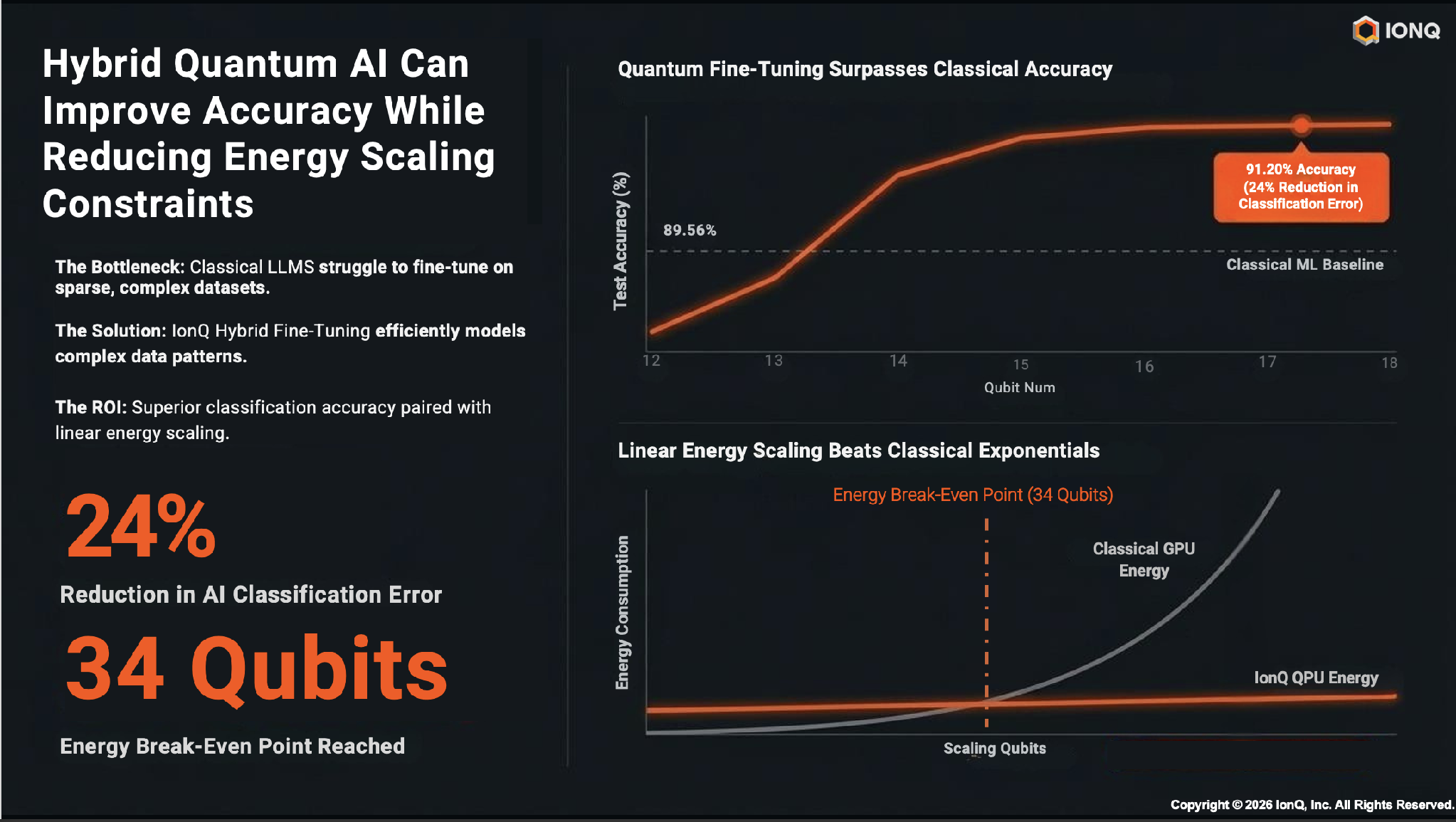
Our empirical hardware measurements show that quantum-enhanced fine-tuning doesn't just match classical baselines, it breaks the traditional trade-off between power and performance. As Daniel Newman, CEO of The Futurum Group, noted in his analysis of this study, our data establishes a clear 'energy break-even' threshold at approximately 34 qubits. Past this point, the linear energy scaling of IonQ’s trapped-ion architecture outpaces the exponential energy curves of classical simulation. In a market that increasingly prices intelligence in watts, this third-party validation proves that accuracy and energy efficiency can finally move in the same direction.
Optimizing total cost of ownership
Given these advances, an effective enterprise strategy might leverage QPUs through a quantum-accelerated data center. Orchestration software could direct a tiered workload: CPUs to take on orchestration and business logic and GPUs for foundation models and inference. QPUs would be best suited for specialized optimization and classification workloads such as supply chain planning, portfolio optimization, and advanced scientific computing problems like molecular simulation, materials discovery, and chemical reaction modeling.
At a time when data center energy consumption seems insatiable and associated costs keep rising, enterprises are finding the TCO of AI infrastructure increasingly difficult to ignore. Adopting quantum fine-tuning can help achieve ESG goals while tempering AI deployment expenses.
Over time, expect data centers to move toward integrating QPUs into their tech stack, which already includes CPUs and GPUs. The final architecture, optimized for AI workloads and energy efficiency, will include integrated quantum-accelerated high-performance computing nodes.
Hardware and applications in lockstep
As the IonQ research shows, enterprises need not wait for fully fault tolerant quantum computers. Combining hardware-driven error correction with software-driven error mitigation, quantum fine-tuning enables extraction of quantum utility from today’s trapped-ion quantum computers.
The key is to synchronize hardware improvements such as qubit counts and gate fidelities with software fine-tuning to maximize end-user solution quality. Next-generation qubit rollouts will need such synchronization to extract maximum utility from quantum computers even as they move through the noisy intermediate-scale phase.
With the advantages of quantum fine-tuning firmly in place, enterprises can milk even today’s quantum hardware for compute efficiencies. Plagued by rising energy costs of AI deployment, they might benefit from adding QPUs to their tech stack today and stay ahead of the global data center energy crisis, forecasted to stall traditional classical competitors by 2027.

