From Magic States to Full-Stack Accounting: How Resource Estimation for Fault-Tolerant Quantum Computing Is Growing Up

At a Glance
- The Old Paradigm: Many fault-tolerant quantum computing (FTQC) resource estimates have long held that non-Clifford operations (such as T and Toffoli/CCZ gates, implemented using magic states) consume the vast majority of a machine’s resources, treating Clifford gates and routing overhead as negligible.
- The Reality Shift: Landmark breakthroughs in magic state cultivation and distillation have slashed magic state overhead by two to three orders of magnitude. Concurrently, full-stack compilation reveals that logical memory, routing, and Clifford operations often account for 50% to over 90% of total physical spacetime volume.
- The Business & Engineering Risk: Optimizing algorithms solely to minimize T-count is now counterproductive - benchmarks demonstrate that a 3% reduction in T-gates can paradoxically inflate physical spacetime by 41% due to surging routing and memory overhead.
- The Strategic Takeaway for CTOs: Evaluating FTQC roadmaps requires moving past isolated hardware metrics or T-gate counts. Industrial utility demands end-to-end compilable benchmarks, flexible architectures that dynamically balance memory versus gate throughput, and architecture-aware software synthesis.
Every decision in fault-tolerant quantum computing (FTQC) rests on a resource estimate: how many qubits, how much time, and what total physical footprint an application will actually need. For enterprise CTOs, quantum leads, and heads of R&D, those estimates determine which use cases to pursue, when to invest, and which platforms to back. For vendors, they determine what gets built: which bottlenecks receive engineering attention and how a machine’s resources are allocated. When estimates are accurate, both sides optimize for the same target. When they rest on outdated assumptions, customers prioritize the wrong applications and vendors spend years optimizing the wrong part of the machine. For two decades, most FTQC estimates rested on a single assumption.
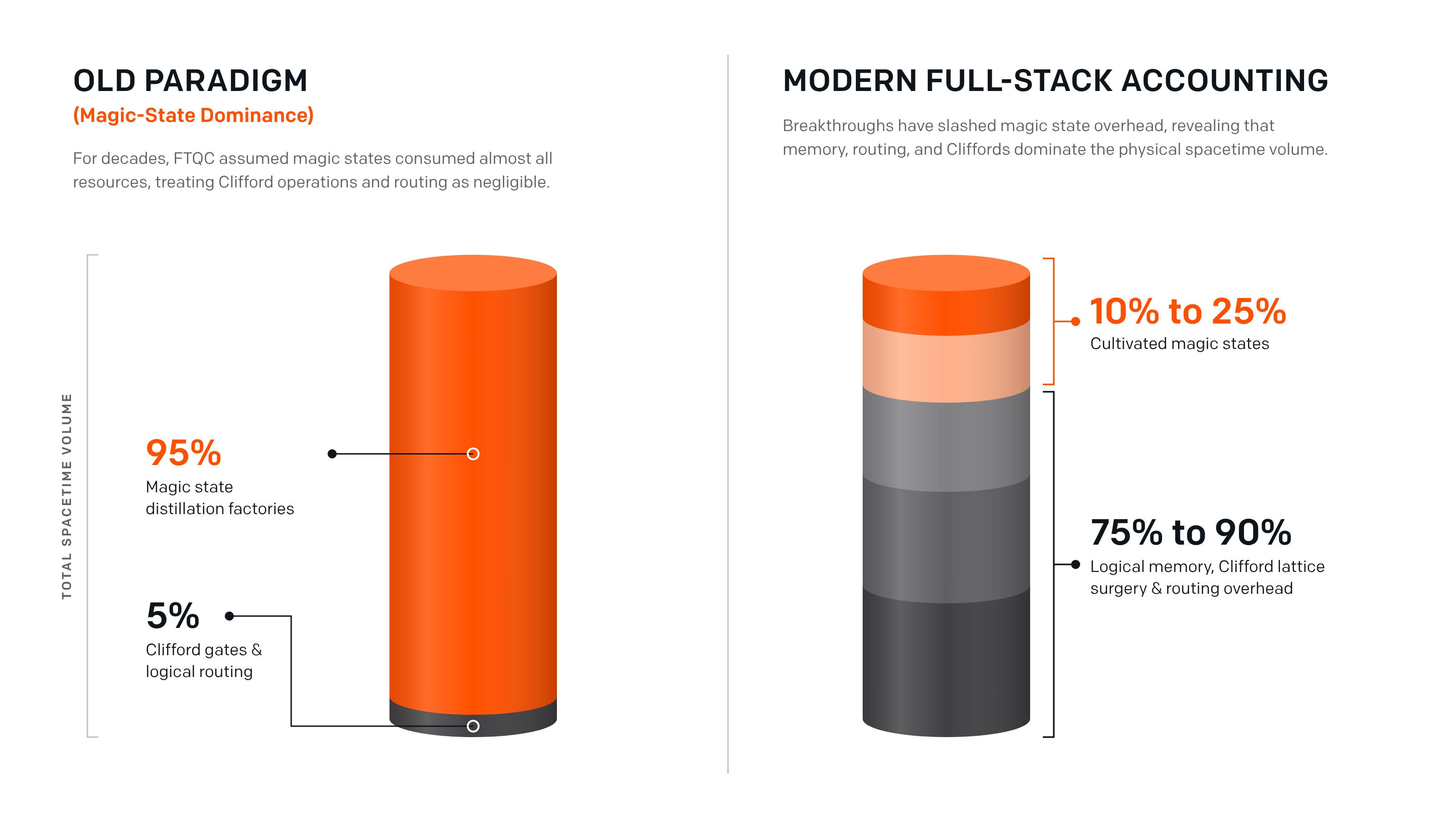
Ask almost anyone who follows the field where the real cost lies, and you’ll hear the same answer: magic states, the resource that powers non-Clifford operations such as T and Toffoli gates. Historically, preparing magic states dominated FTQC resource estimates, often exceeding 95% of the total qubit-cycle volume, while other costs were treated as negligible [1].
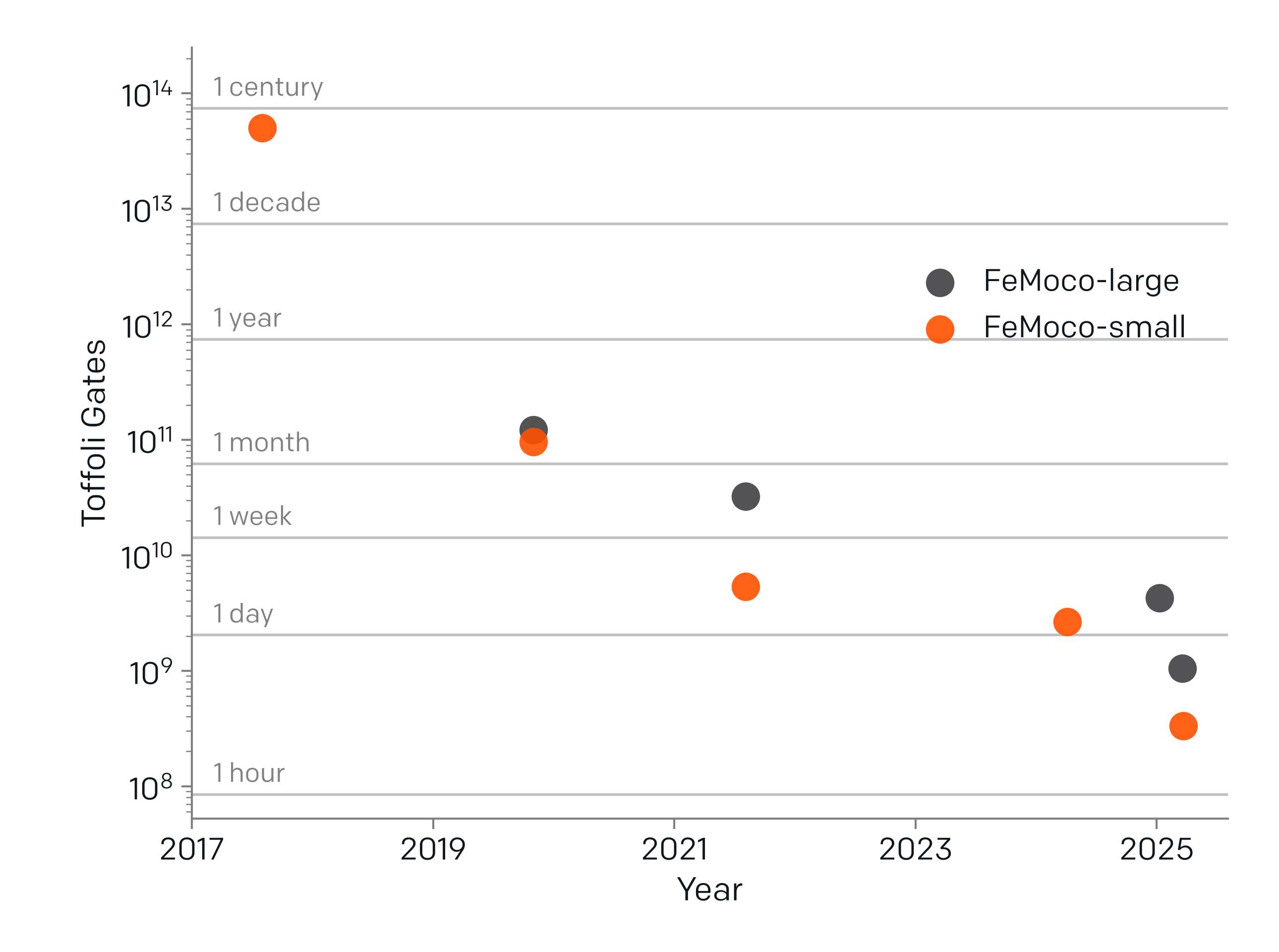
There were good reasons for this view, but the picture has shifted. In their recent perspective on the grand challenge of quantum applications, Google Quantum AI researchers note that “recent advances have called into question the primacy of this cost model [non-Clifford gate count], diminishing the historical cost gap between T gates and Clifford gates” [2]. Modern FTQC resource estimates tell a new story: in many architectures, Clifford operations, the supposedly cheap part, consume a large share of the machine, along with the layout, routing, and compilation that stitch everything together. The good news is that the field’s understanding of fault tolerance is maturing fast, and costs keep falling.
A quick primer: Cliffords and magic
Fault-tolerant quantum circuits are built from two families of operations. Clifford gates (CNOTs, Hadamards, S gates) are the workhorses: they manipulate and entangle quantum information, and error-correcting codes handle them relatively naturally. Non-Clifford gates, typically T gates, give quantum computers their power beyond efficient classical simulation. Most fault-tolerant schemes don’t apply T gates directly. Instead, the machine prepares special resource states, called magic states, and consumes one to enact each gate.
A famous theoretical result reinforced the intuition that magic is precious: Clifford-only circuits can be simulated efficiently on a classical computer, while the best-known classical simulations scale exponentially with the number of magic states. For a long time, the engineering numbers agreed. In their landmark 2007 analysis of topological fault tolerance, Raussendorf, Harrington, and Goyal put the cost of a T gate two to three orders of magnitude above that of a CNOT [3]. With a gap that large, designing architectures around magic state factories and ranking algorithms by T count was the right call, and it became the field’s default.
What changed
Two things changed, one on each side of the ledger.
Magic got cheap. A steady stream of improvements in magic state production has compounded into a dramatic cost reduction. In 2019, Litinski’s aptly titled “Magic State Distillation: Not as Costly as You Think” showed that distillation circuits can run at much lower code distances than previously assumed; in extreme cases, distilling a magic state can cost less than a logical Clifford gate [4]. In 2024, Gidney, Shutty, and Jones introduced magic state cultivation, which produces high-fidelity T states with roughly the same physical resources as a lattice-surgery CNOT, and suggested that dedicated distillation factories may never be needed in practice [5]. Between the 2007 and 2024 estimates, the operational cost of a magic state, measured in physical operations, fell by two to three orders of magnitude. The gap between T gates and CNOTs has essentially closed.
Cliffords were never free. The second shift is subtler. Early estimates treated Clifford operations as nearly costless, but they predate complete, compilable FTQC architectures. Without a real compiler, the overhead hidden in the details stayed invisible: laying out logical qubits, routing interactions across the chip, scheduling lattice-surgery operations, and the spacetime volume these steps consume. Today, compilers map full algorithms onto fault-tolerant architectures, and the accounting is far more complete. Wang et al. [1] identify Clifford operations as a major, previously overlooked source of FTQC overhead.
This is where intentional circuit synthesis becomes critical, and purpose-built tools are emerging to support it. High-level quantum programming models let developers describe the intended computation without committing to a single gate-level implementation. For today’s noisy machines, synthesis engines search over implementations using objectives such as width, depth, and two-qubit-gate count. For fault-tolerant machines, that approach is being extended to architecture-aware proxy metrics, including logical spacetime, non-Clifford demand, routing, and code-specific operation costs, so the compiler can optimize for the machine that will actually run the circuit.
Why this matters
To be clear, resource estimation (including circuit optimization) remains a complex, multi-variable problem. Architectures face different constraints, and for some applications on some machines, T gates will still dominate. “Magic is cheap” would be as much an oversimplification as “magic is expensive.” But the default has changed: T-gate dominance is no longer the typical case.
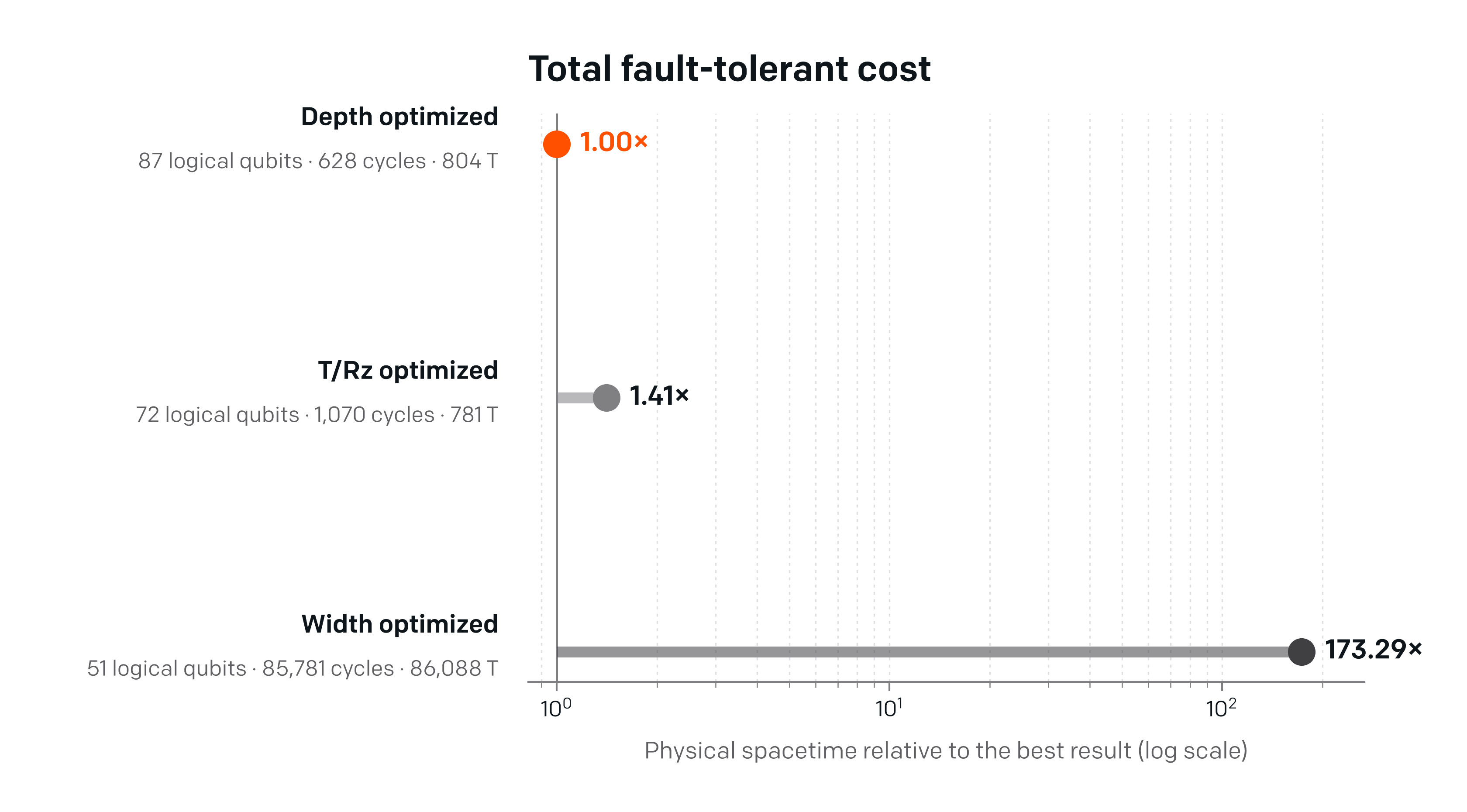
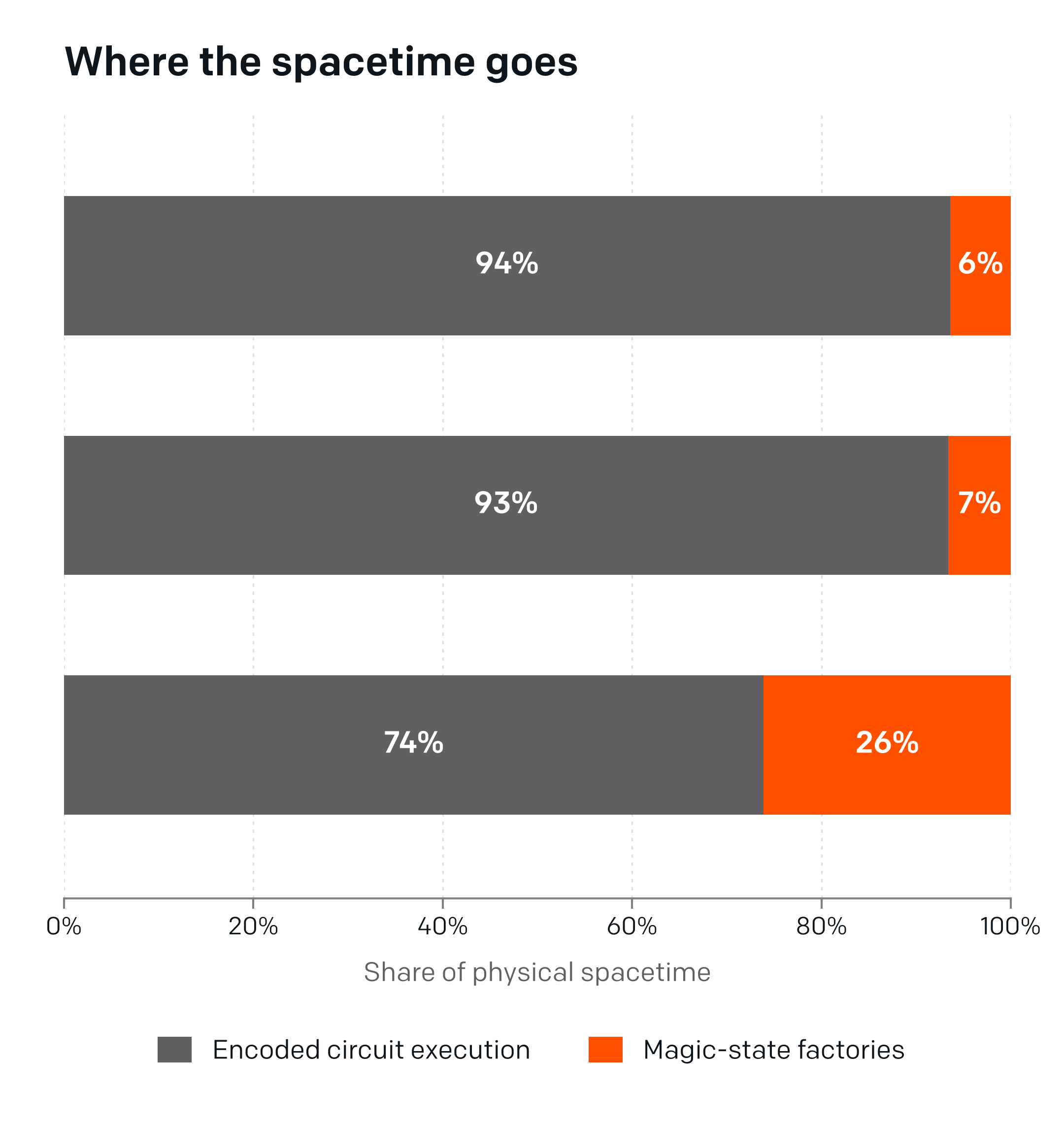
An experiment by Classiq illustrates the effect. Starting from a single Grover-style program written in its high-level Qmod language, the synthesis engine produced functionally equivalent circuits optimized for depth, width, or T/Rz cost. Under a transversal fault-tolerance model, the T/Rz-optimized circuit used 3% fewer T states than the depth-optimized circuit, yet required 41% more physical spacetime. The narrowest implementation required 173 times more spacetime than the best one. Across these implementations, magic state factories accounted for only 6–26% of total spacetime; encoded memory and circuit execution accounted for the remaining 74–94%. Selecting by T count alone would have picked the wrong circuit and misranked the rest (Figure 3).
IonQ’s recent resource estimate for breaking 256-bit elliptic curve cryptography on IonQ’s Walking Cat architecture [6] shows the same pattern [7]. The compiled algorithm uses about 39 million Toffoli gates and only about 11,000 T gates; everything else is Clifford. At 29.5 ms per Toffoli, the Toffolis alone would take about 13.3 days, yet the full computation would run for 25.7 days. Magic would account for roughly half the runtime, not 99%.
That has real consequences for how to read the field. Comparisons based solely on T count may misrank candidate algorithm implementations. Architectures capable of dynamically rebalancing magic state throughput against logical memory gain a structural advantage under full-stack accounting. Similarly, hardware features that reduce routing and layout overhead, such as high-degree qubit connectivity and flexible, multiplexed qubit control, take on greater importance when Clifford and routing costs dominate.
Software optimization complements hardware architecture. A single high-level operation may admit many arithmetic constructions, ancilla strategies, uncomputation schemes, and gate decompositions. Spending additional logical qubits can shorten the critical path; minimizing width can produce a much deeper circuit; and reducing T count can increase Clifford, routing, or memory overhead. By exploring these choices hierarchically, before committing to quantum assembly, an architecture-aware compiler can search for the implementation that minimizes an architecture-relevant cost rather than a single universal gate count.
This creates a natural hardware-software co-design loop. A flexible architecture can shift physical resources between logical memory and magic state throughput, while a synthesis engine can generate implementations with different demands for qubits, depth, entangling operations, and magic states. An architecture-aware workflow could co-optimize circuit synthesis with hardware resource allocation for a wide range of fault-tolerant applications, potentially accelerating the path to industrial utility.
What this means for you
Enterprise CTOs, quantum leads, and heads of R&D evaluating use cases should ask three questions. First, is the FTQC roadmap backed by end-to-end compilation that shows how real applications run on the architecture? Second, can the architecture reallocate resources dynamically through software, changing error-correction codes, logical qubit count, and magic state throughput as workloads demand? Third, can your development platform compile your own applications end to end?
For hardware and software providers across the industry, these same questions set the standard. Customers can compare platforms objectively only if vendors publish compiled, end-to-end estimates against shared, reproducible benchmarks. As the cost model for fault tolerance evolves, application-specific full-stack accounting of resource requirements will be essential for building realistic quantum roadmaps.
About the Authors
Zeljko Susnjar is a Senior Quantum Field Engineer at IonQ, where he helps enterprises across the globe translate quantum computing into practical business value. Zeljko combines hands-on quantum application development with deep enterprise technology expertise, including extensive experience leading engineering teams, corporate strategy, and M&A at EMC, Cisco, and Nutanix. He holds an MSc in Electrical Engineering/microwaves electronics.
Zheng Cui is the VP Field Engineering at IonQ, where he leads technical go-to-market. Zheng has a combination of deep technical expertise in quantum technologies and extensive experience in strategy consulting with large enterprises and organizations. Zheng has a PhD in quantum computing and sensing from Stanford University, and was formerly a Partner at the Boston Consulting Group prior to joining IonQ.
Gilad Kishony leads the quantum error correction research team at Classiq, developing methods for fault-tolerant quantum computing. He holds a PhD in physics from the Weizmann Institute of Science, where he worked with Prof. Erez Berg. His research bridges many-body physics and quantum information, with a focus on topological quantum states and quantum error-correcting codes.
Ron Cohen leads the quantum error correction development team at Classiq, focusing on bridging high-level quantum programming with fault-tolerant quantum computing. Previously, Ron worked on Classiq’s applications team, bringing a background in electrical engineering and research experience in quantum error correction, signal processing algorithms, and hardware development.
Avi Elazari brings three decades of experience in chip design and VLSI to his work in quantum computing at Classiq. He holds a degree in electrical engineering from the Technion and previously worked at Motorola, Marvell, and CEVA. His work at Classiq spans quantum circuit optimization, efficient gate synthesis, and quantum error mitigation.
Frequently Asked Questions (FAQ) for CTOs
1. Why does the collapse of the "magic state bottleneck" invalidate our existing FTQC timeline and cost models?
Historically, quantum roadmaps and algorithm valuations were modeled on non-Clifford gate counts as the single proxy for execution time and cost. Because modern techniques (such as magic state cultivation) have lowered magic state preparation costs to near parity with logical Clifford gates, non-Clifford counts no longer govern overall runtime or footprint. If your teams or prospective vendors evaluate quantum feasibility using legacy T-count estimators, they risk optimizing the wrong architectural layers, overestimating the barrier of non-Clifford algorithms, and underestimating the physical overhead of routing, qubit layout, and Clifford execution.
2. What specific validation should we demand from quantum vendors before trusting their resource estimates?
Insist on compiled, end-to-end full-stack accounting rather than theoretical gate counts or raw physical qubit projections. Specifically, ask vendors:
- Has this workload been compiled down to physical lattice-surgery or hardware-native operations, accounting for routing, layout, and logical memory idle time?
- What fraction of total spacetime volume is dedicated to magic state generation versus encoded memory and Clifford routing?
- Can your hardware dynamically reallocate physical qubits between active memory and magic state throughput as algorithm phases shift?
3. How should our internal quantum and R&D teams adapt their software and algorithm development workflows today?
Shift development away from manual, low-level gate minimization and toward architecture-aware, high-level circuit synthesis. Because trade-offs are multidimensional - where reducing circuit width or T-count can drastically blow out circuit depth, uncomputation cost, or communication overhead - teams should utilize compilers that optimize globally for hardware-specific constraints (e.g., connectivity, native gate times, and error-correction models) rather than optimizing against a single universal metric.
References
- M. Wang et al., “Transpiler-Architecture Co-Design to Curb Clifford Costs in Fault-Tolerant Quantum Computing,” Proc. 53rd Annual International Symposium on Computer Architecture (ISCA 2026); arXiv:2412.15434.
- R. Babbush et al. (Google Quantum AI), “The Grand Challenge of Quantum Applications,” arXiv:2511.09124 (2025).
- R. Raussendorf, J. Harrington, and K. Goyal, “Topological fault-tolerance in cluster state quantum computation,” New J. Phys. 9, 199 (2007); arXiv:quant-ph/0703143.
- D. Litinski, “Magic State Distillation: Not as Costly as You Think,” Quantum 3, 205 (2019); arXiv:1905.06903.
- C. Gidney, N. Shutty, and C. Jones, “Magic state cultivation: growing T states as cheap as CNOT gates,” arXiv:2409.17595 (2024).
- F. Tripier et al. (IonQ), “Fault-Tolerant Quantum Computing with Trapped Ions: The Walking Cat Architecture,” arXiv:2604.19481 (2026).
- T. Häner et al. (IonQ), “Computing 256-bit elliptic curve discrete logarithms in 26 days on a fault-tolerant trapped-ion quantum computer with 20,000 qubits,” arXiv:2609.05625 (2026).

