Bridging a Historical Divide in Quantum Computing

New research from IonQ and its partners merges quantum’s origin story and its future roadmap to show real results today
We are living through a fundamental rewrite of the computing stack. History shows that whenever the cost of raw processing power drops by an order of magnitude, the rules of software change overnight. We saw it when room-sized mainframes yielded to silicon microprocessors, and again when video game GPUs were repurposed for matrix math - overnight turning deep learning from an academic curiosity into a modern reality. Today, an unprecedented explosion in parallel compute is forcing another total paradigm shift, moving us from rigid, hand-coded logic to dynamic, compute-heavy intelligence.
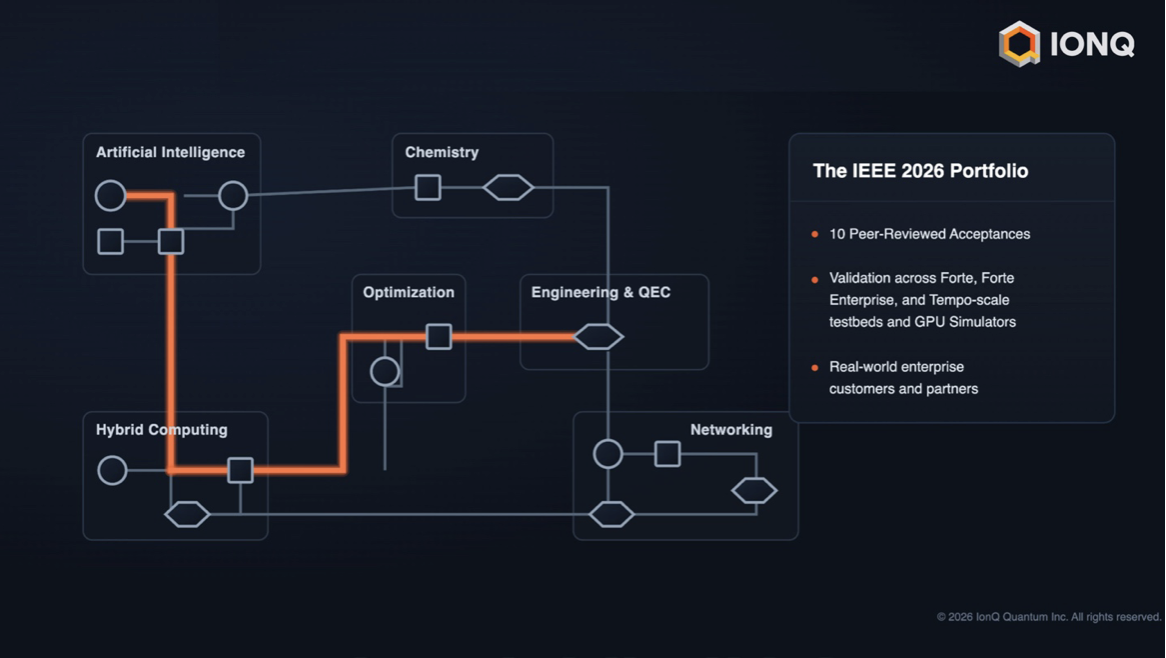
IEEE QCE26 marks a milestone in the sector’s continuous evolution, driven by IonQ and its partners. Academic discovery and enterprise readiness are converging into a unified path forward, with IonQ demonstrating this ongoing progress through 10 accepted peer-reviewed papers that bridge foundational theory with practical enterprise application. Four of these papers earned medals in their respective IEEE QCE26 conference tracks, including two first-place awards for the following research:
- Quantum Applications track — "Measuring Accuracy and Energy-to-Solution of Quantum Fine-Tuning of Foundational AI Models" (joint work with customer QBasel)
- Quantum End-to-End Hybrid Case Studies track — "End-to-End Performance of Quantum-Accelerated Large-Scale Linear Algebra Workflows" (joint work with partner Synopsys)
Two other papers were #3rd Best Paper in their respective tracks:
- Quantum End-to-End Hybrid Case Studies track — "Protein Folding on a 64-Qubit Trapped-Ion Hardware via Counterdiabatic Quantum Optimization" (joint work with partner Kipu)
- GenAI Co-Design & Co-Discovery track — "DQAOA-GPT: AI-Accelerated Distributed Quantum Optimization for Combinatorial Problems" (joint work with partners/customers Oak Ridge and Nvidia)
Notably, IonQ’s work won both Best and 3rd Best papers in the Quantum End-to-End Hybrid Case Studies track at the prestigious IEEE QCE conference.
IonQ’s full list of papers cover a wide variety of topics with real-world business implications, such as how IonQ is scaling hybrid quantum-classical workflows up to 150 qubits to improve the economics and efficiency of industrial simulations. They illustrate how IonQ’s quantum hardware is directly interfacing with classical high-performance computing (HPC), optimizing supply chain logistics, accelerating AI pipelines, and more. These papers represent what IonQ is accomplishing right now by merging algorithmic innovation with increasing hardware maturity to deliver operational value within existing enterprise workflows.
How Quantum Is Advancing on Three Structural Pillars
The research collected in IonQ’s IEEE papers centers around three structural pillars that represent momentum across key parts of IonQ’s full stack approach.
The first pillar is “Real-World Industrial Impact & Optimization.” This is where IonQ and its partners have put hybrid quantum-classical workflows and quantum computing hardware to work on real-world commercial applications and optimization challenges that have shown to be intractable for classical algorithms and computers alone.
The second pillar is “The Synergy of Quantum & AI.” That synergy is being exhibited in a number of ways, from how quantum and AI technologies integrate with another to the effect they can have on training of neural networks and machine learning models, as well as AI inference.
The third pillar is “Architectural Resilience & Overcoming the Noise Barrier.” The era of fault-tolerant quantum computing is almost here, but there is still work to do as we strive to improve the performance, accuracy, and reliability of quantum hardware. The papers revolving around this pillar aim to show how the platforms of today’s Noisy Intermediate-Scale Quantum era are evolving toward the fault-tolerant systems of tomorrow.
Here’s a closer look at each of the papers IonQ is highlighting at IEEE QCE26:
Pillar 1: Real-World Industrial Impact & Optimization
Focus: Demonstrating how hybrid quantum-classical workflows can be seamlessly woven into enterprise engineering software, fluid dynamics, and supply chain logistics to provide measurable operational efficiency.
- "End-to-End Performance of Quantum-Accelerated Large-Scale Linear Algebra Workflows"
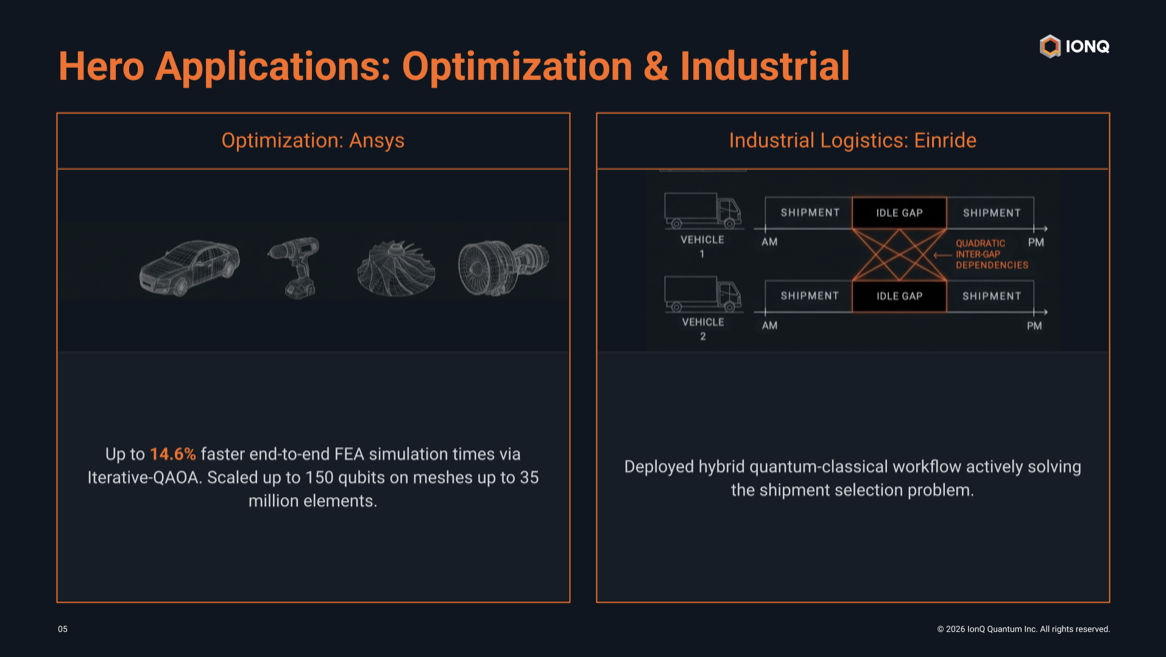
- Finite Element Analysis (FEA) simulations evaluate structural integrity for machine components in many industries, and reducing time-to-solution lowers computing costs and increases FEA productivity. In this research, a quantum-classical solver for the Graph Partitioning Problem (GPP) was integrated into Synopsys/Ansys LS-DYNA multiphysics FEA simulation software. GPP is important for reducing sparse-matrix processing costs in complex finite element meshes. We tested workflows involving meshes of up to 35 million elements, scaling up to 150 qubits in NVIDIA's CUDA-Q/cuTensorNet simulations and 36 qubits on IonQ Forte hardware, with best-case wall-clock-time improvements of 14.6% and approximately 12%, respectively.
- Link: arXiv:2603.15515
- "Hybrid Quantum-Classical Optimization Workflows for the Shipment Selection Problem"
- IonQ and electric freight transportation firm Einride developed a hybrid quantum-classical workflow to address the complex combinatorial optimization problem presented by idle gaps in fleet scheduling caused by shipment cancellations and other disruptions. Quantum-derived solutions warm-started Einride’s optimizer, delivering up to 12.1% more shipments in the best-performing scenario without materially changing operational costs. Hardware runs on IonQ’s trapped-ion system matched simulations for instances up to 35 qubits, while larger problems up to 130 qubits were simulated, highlighting quantum computing’s potential value for large-scale logistics.
- Link: https://arxiv.org/abs/2604.11758
- "Quantum Lattice Boltzmann Solutions for Transport Under 3D Spatially Varying Advection on Trapped Ion Hardware"
- In a major milestone for computational fluid dynamics (CFD), IonQ and Ansys teamed up on the first high-fidelity hardware demonstration of complex 3D advection-diffusion fluid behavior with non-uniform velocity fields and boundaries. The demonstration, using the hybrid Quantum Lattice Boltzmann Method (QLBM) algorithm framework for CFD and transport simulations, was executed on IonQ’s trapped-ion Forte systems and a 64-qubit Barium development system similar to the forthcoming IonQ Tempo line. For companies leveraging CFD, this achievement could lead to faster R&D and more realistic fluid modeling using fewer computing resources.
- Link: https://arxiv.org/abs/2604.28121
Pillar 2: The Synergy of Quantum & AI
Focus: Emphasizing how quantum computing can act as a force multiplier for modern AI—improving model accuracy, optimizing training phases, and unlocking new capabilities in data-heavy fields.
- "DQAOA-GPT: AI-Accelerated Distributed Quantum Optimization for Combinatorial Problems"
- IonQ, Oak Ridge National Laboratory, and Nvidia showcase real-world quantum-AI convergence with the new distributed quantum approximate optimization algorithm-generative pre-trained transformer model (DQAOA-GPT). This hybrid framework integrates the DQAOA, which decomposes large optimization problems into smaller sub-problems, with GPT-based quantum circuit generation for solving those sub-problems. Merging quantum optimization of combinatorial challenges and learned, AI-driven circuit generation results in lower computational overhead and costs and greater ability to tackle larger optimization challenges compared to the iterative variational optimization technique typically used.
- Link: https://arxiv.org/abs/2607.20225
- "Measuring Accuracy and Energy-to-Solution of Quantum Fine-Tuning of Foundational AI Models"
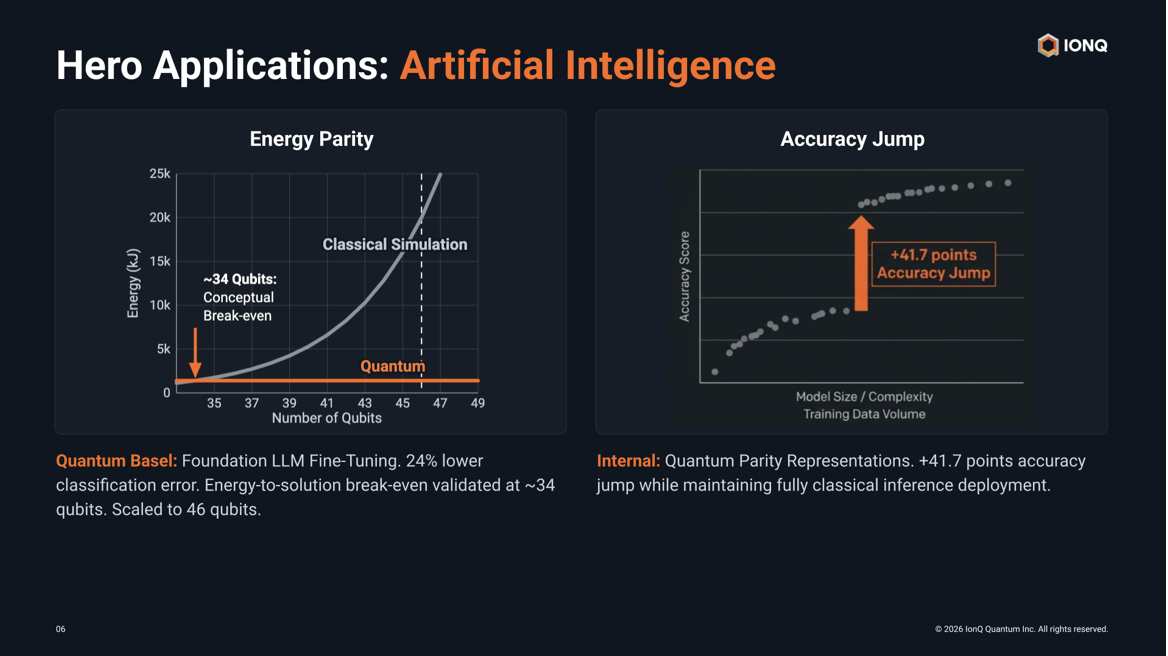
- Previous IonQ research demonstrated that quantum neural networks can effectively fine-tune pretrained classical AI models for flexible customization to specific classification tasks. This new work, done in partnership with QuantumBasel, successfully executed these quantum fine-tuning circuits on real QPU hardware, an IonQ Forte Enterprise machine, achieving a 24% reduction in error over classical fine-tuning baselines in the ideal/noiseless simulation case. Analysis of the energy consumed by these circuit runs demonstrated a clear path to favorable energy efficiency for quantum hardware, with a suggested break-even energy-to-solution crossover point near 34 qubits when compared with classical simulation.
- Link: arXiv:2605.02798
- "Scalable On-Hardware Training of Quantum Neural Networks and Application to Clinical Data Imputation"
- IonQ and Quantum Signals demonstrated a high-stakes healthcare application by using quantum neural networks (QNNs) to intelligently fill missing gaps in Electronic Health Records (EHRs). We validated a hybrid quantum-classical training framework for gradient-based optimization of QNNs on near-term processors, tasking it with clinical data imputation on the MIMIC-III dataset, which contains tens of thousands of patient EHRs. Quantum models ran on IonQ’s Forte Enterprise at 16 qubits without performance degradation and via tensor-network simulation at 32 qubits, with 32-qubit inference executed on hardware. The models matched or exceeded strong classical neural baselines while exhibiting reduced variance across runs, showing practical, scalable QNN training under near-term hardware constraints.
- Link: https://arxiv.org/abs/2606.03517
- "Quantum Parity Representations for Classical Machine Learning: Learnable Basis Discovery and Encoder Recovery"
- This research has economic implications for companies that are aiming to minimize hardware costs during AI model inference. It explored parity-based representations for classification, as they are expressive but cheap to compute. The work highlights an asymmetric hybrid paradigm where quantum resources are used strictly during the training phase to uncover hidden binary coefficient vectors. Solving this natively classically corresponds to an exponential enumeration of all possible binary vectors. After the binary vector is discovered, model inference runs entirely on a classical device, and is even cheap enough to be deployed on the edge. In the research, the discovered binary vector words improved mean accuracy by 23.9% to 41.7% over evaluated classical baselines.
- Link: https://arxiv.org/abs/2605.11213
Pillar 3: Architectural Resilience & Overcoming the Noise Barrier

Focus: Highlighting IonQ's increasing hardware maturity and technical rigor, showing how sophisticated noise modeling, hardware features, and error mitigation extract maximum computational utility from current-generation systems.
- "Mid-Circuit Measurements for Clifford Noise Reduction in Hamiltonian Simulations"
- Collaborating with NVIDIA and qBraid, this work showcased the unique mid-circuit measurement (MCM) capabilities of IonQ Tempo to scrub out errors during complex chemical and molecular simulations. Researchers combined Generalized Superfast Encoding (GSE), Clifford Noise Reduction (CliNR), and MCM techniques, and when run with Nvidia’s accelerated computing software, this approach achieved a 54% lower error rate than in direct physical Trotter runs. A lower error rate ultimately translates to more accurate and efficient simulations, lower R&D costs, and faster time-to-market for enterprises leveraging these processes.
- Link: https://arxiv.org/abs/2605.06792
- "Protein Folding on a 64-qubit Trapped-Ion Hardware Via Counterdiabatic Quantum Optimization"
- Protein folding, the process by which chains of amino acids adopt three-dimensional structures that enable biological functions, is key to accelerating drug discovery and reducing associated R&D costs. IonQ and Kipu studied six peptides with a geometrically constrained lattice model with protein folding workloads of 46-61 qubits. In what we believe is the largest showcase of trapped-ion quantum protein folding optimization to date, researchers applied bias-field digitized counterdiabatic quantum optimization for lattice protein folding on up to 61-qubit instances on a 64-qubit Barium development system similar to the forthcoming IonQ Tempo line.
- Link: https://arxiv.org/abs/2604.26861
- "Spectral-Interpolation Framework for Colored Noise in Quantum Circuits"
- This paper, which will be presented during the IEEE conference by co-author Dor Gabay, focuses on IonQ's sophisticated internal noise-modeling capabilities, presenting a robust framework for predicting and mitigating circuit errors. Specifically, researchers studied colored noise, which can be hard to model because, unlike white noise, it has uneven signal power distribution across frequencies and temporal correlations across samples. Researchers coupled a spectral representation of stochastic noise processes on the classical side to precomputed, operator-valued noise artifacts on the quantum side through parameter-space interpolation to model noisy circuit evolution.
- Link: Conference Presentation / Workshop
What Our Collective Research Portfolio Reflects
Academic research is the foundation of the quantum industry, but we have come a long way from evaluating quantum algorithms in a pure academic vacuum. IonQ and its partners are also now defining the formal engineering rules of engagement for hybrid quantum-classical architectures, and doing so on several different fronts at once.
Our research demonstrates that maximum computational utility and enterprise value are unlocked through hybrid execution - combining targeted quantum processing with classical pre- or post-processing stages where they add the most leverage. In doing so, we highlight the immediate viability of NISQ-era hardware by leveraging hardware-native features like mid-circuit measurement and internal noise modeling to achieve high-fidelity results today, proving we do not need to wait for full fault tolerance to deliver actionable business impact and commercial value.
It is also important to note that IonQ is not accelerating this integrated evolution on its own. Showcasing real-world performance gains, quantum-AI synergy benefits, and architectural quality improvements requires teamwork. Tandem development with partners like Nvidia, Synopsys/Ansys, Einride, and more across hardware, custom algorithms, and industrial software stacks is invaluable in pushing this evolution forward.
With these research advancements, IonQ is not only seeing its academic and commercial quantum computing timelines converge, but also is driving quantum computing to come into its own as a functional, active component of the broader modern computing ecosystem. We expect that the impact of sharing these concrete architectural milestones with the global IEEE community will be the further acceleration of quantum computing toward the center of this ecosystem.
IonQ Forward-Looking Statements
This document contains forward-looking statements, including statements regarding the timing of fault-tolerant quantum computing and the impact of sharing the information contained in this document. These statements are only predictions based on our expectations on the date of this document and are subject to a number of risks, including, among others, those described in our Annual Report on Form 10-K for 2025 and our Quarterly Report on Form 10-Q for the second quarter of 2026, each filed with the SEC. New risks emerge from time to time. We undertake no obligation to update any forward-looking statement, except as required by law.

