A Platform Solution to the Deep Trotter Dilemma: Improving Quantum Chemistry Simulations

A low-overhead path to lower error rates in quantum simulations of molecular interactions
The importance of improving quantum chemistry simulations
Complex chemistry simulations are key to accelerating drug discovery, advancing innovations in material science, and delivering results that drive greater value across multiple industry verticals. But, the molecular interactions occurring in these simulations result in scaling bottlenecks too intractable for classical computers to overcome alone.
Quantum simulations offer hope through their ability to replicate the quantum nature of molecules and, through exponential scaling capabilities, assess in reasonable time the behavior of molecules as they interact. Yet, even quantum simulations can be fraught with cascading noise and errors that limit their overall efficacy.
Present-day systems tackling these challenges require the use of techniques to reduce noise and, in the absence of true quantum error correction (QEC), mitigate errors. Because trapped ions possess exceptionally high gate fidelities and absolute all-to-all connectivity, they are well suited for computational chemistry. As demand for fermionic simulations continues to grow, and the size of simulations continues to scale, techniques for noise reduction and error detection and mitigation can be supported by native mid-circuit stabilizer measurement. This enables quantum states to be measured in-flight and error syndromes extracted unobtrusively before a quantum algorithm concludes its computational work. Together, these capabilities offer a practical path to lower error rates today, ahead of true fault-tolerant quantum computing (FTQC).
New research co-authored by IonQ, qBraid, and NVIDIA establishes how an approach combining Generalized Superfast Encoding (GSE) and Clifford Noise Reduction (CliNR) enabled by Mid-Circuit Measurement (MCM) on trapped-ion systems reduces noise, mitigates errors, and results in improved complex chemistry simulations. Validated alongside accelerated software from NVIDIA, this application-native mitigation approach delivers a 54% lower error rate than in direct physical Trotter runs.
A lower error rate could ultimately translate to more accurate and efficient simulations, potentially lower R&D costs, and may decrease time-to-market for enterprises leveraging these processes.
The Structural Limitations of Deep Trotter Circuits
Advancing the frontier of chemistry and material science research involves the simulation of large-scale and highly complex interactions of fermionic systems. This requires Trotterization, a method which leverages deep quantum circuits to break down the time-evolution of these interactions into smaller, more manageable Hamiltonian equations. Yet, a conundrum therein awaits as every successive Trotter step and increase in circuit depth cascades and amplifies accumulated physical noise until the target signal is entirely destroyed. This foundational bottleneck represents a "deep Trotter dilemma” where deep circuits are needed to achieve the desired accuracy but each gate in the circuit can contribute an error.
The Architecture of Mitigation: GSE, CliNR, and Accelerated Software Platforms
Implementing Advanced Encoding and Mitigation Protocols
While quantum simulations of complex fermionic system interactions traditionally have used approaches like Jordan-Wigner transformations for the mapping of fermions to qubits, this type of method involves the use of long, non-local Pauli operator strings that require deeper quantum circuits, thereby increasing the likelihood of cascading noise. GSE, however, leverages lower Pauli weight and reduces the non-local tail of qubits involved, thus localizing the simulated interactions and bringing circuit depth requirements into shallower territory. Also, GSE by design includes local Majorana operators and loop stabilizers with inherent error-detection capabilities.
Bringing an MCM capability to the table means that stabilizer measurements can be taken mid-circuit to verify resource states and validate teleportation operations before the end of an algorithm run. MCM allows for the state of qubits to be measured, and for those same qubits to be reset to zero so that they can be reused later in a simulation, promoting more efficient use of qubit resources. If errors are detected mid-flight, they can be dynamically fixed so that they do not influence the end-of-circuit output.
Meanwhile, in addition to the error detection capability provided by GSE, CliNR, which is based on an earlier breakthrough by IonQ researchers, provides a low-overhead noise reduction solution interim to future QEC. The CliNR protocol works by preparing a Bell+Clifford resource state, measuring a small set of its stabilizers, discarding faulty preparations, and teleporting the accepted Clifford operation onto the data register. Off-data verification allows faults to be detected before they become a bigger issue. CliNR in previous research was established to have a 3:1 physical-to-logical qubit overhead, compared to other approaches that may require many more physical qubits for noise reduction and error correction.
Leveraging IonQ’s trapped-ion strengths and the NVIDIA ecosystem
Researchers in this case brought all of these techniques to bear using a Barium-based development system similar to IonQ’s Barium trapped-ion Tempo-class quantum computing systems, demonstrating a powerful hybrid workflow where NVIDIA accelerated computing and IonQ QPUs work together as complementary technologies. Rather than competing, these platforms pair accelerated classical infrastructure with advanced quantum hardware to unlock new performance levels. Trapped-ion environments allow any qubit to interact and entangle with any other qubit in a space in a single step regardless of distance between the two, which promotes overall faster algorithmic operations. IonQ’s Tempo class also uses techniques such as laser precision, atomic isolation, and dynamic decoupling to enable low crosstalk and extended coherence times. Most significantly as it pertains to this research, the Tempo class supports the dynamic functionality of MCM.
This research used cuStabilizer, a high-performance library for stabilizer quantum simulations that is a part of the NVIDIA cuQuantum SDK. It also leveraged the NVIDIA CUDA-Q platform and cuQuantum software stack to run stabilizer checks for quantum circuits on GPUs and validate hardware results. Researchers selected cuStabilizer because it is highly optimized for GPU-acceleration through bit-packed stabilizer representations and batched Galois Field operations, enabling high throughput for large numbers of shots, or algorithm execution attempts.
The Power of "Now": Active Mid-Circuit Intervention
Active Noise Reduction vs. Passive Post-Selection
One reason why it is important to have a quantum simulation architecture that supports large numbers of shots is because of the effort required to get noisy quantum states to yield deterministic data in the absence of FTQC.
There are different approaches that can be taken to mitigating errors in such environments. For example, passive post-selection noise reduction involves the purging of error-fraught algorithm runs after the simulations are completed. In contrast, an Active CliNR approach intercepts and arrests errors mid-computation through mid-circuit intervention and measurement of qubit states. Isolating and capturing errors mid-computation keeps errors from propagating and contaminating other surrounding logical code blocks, and improves the probability of a lower error-rate being achieved in each algorithm shot.
This represents a paradigm shift away from discarding corrupted data during post-processing, as it increases the likelihood of each algorithm shot having useful, viable data, and decreases the probability of post-processing waste. For real-world use cases in fields like chemistry and material science, this translates to more accurate quantum simulation results (due to less noise and fewer errors) and greater efficiency (through qubit reuse, less purging of data, and more value to be seen in each algorithm run), ultimately boosting the reliability and trustworthiness of the results of a simulation project.
The Critical Timing Mandate
Empirical data from this research reveals not only a 54% lower error rate, but also that the 54% advantage drops completely to zero if physical measurements are deferred to the conclusion of the circuit, as is the case with passive post-selection noise reduction. This indicates that active MCM is an absolute key to achieving the benefits mentioned above.
Essentially, all of these techniques–GSE and CliNR supported by MCM–can be used to suppress destructive “hook errors” that may begin as a single-qubit error but then propagate throughout an entire algorithm to potentially cause a quantum simulation to fail.
Machine Learning at the Edge: Stabilizer Selection
Solving the Combinatorial Optimization Nightmare
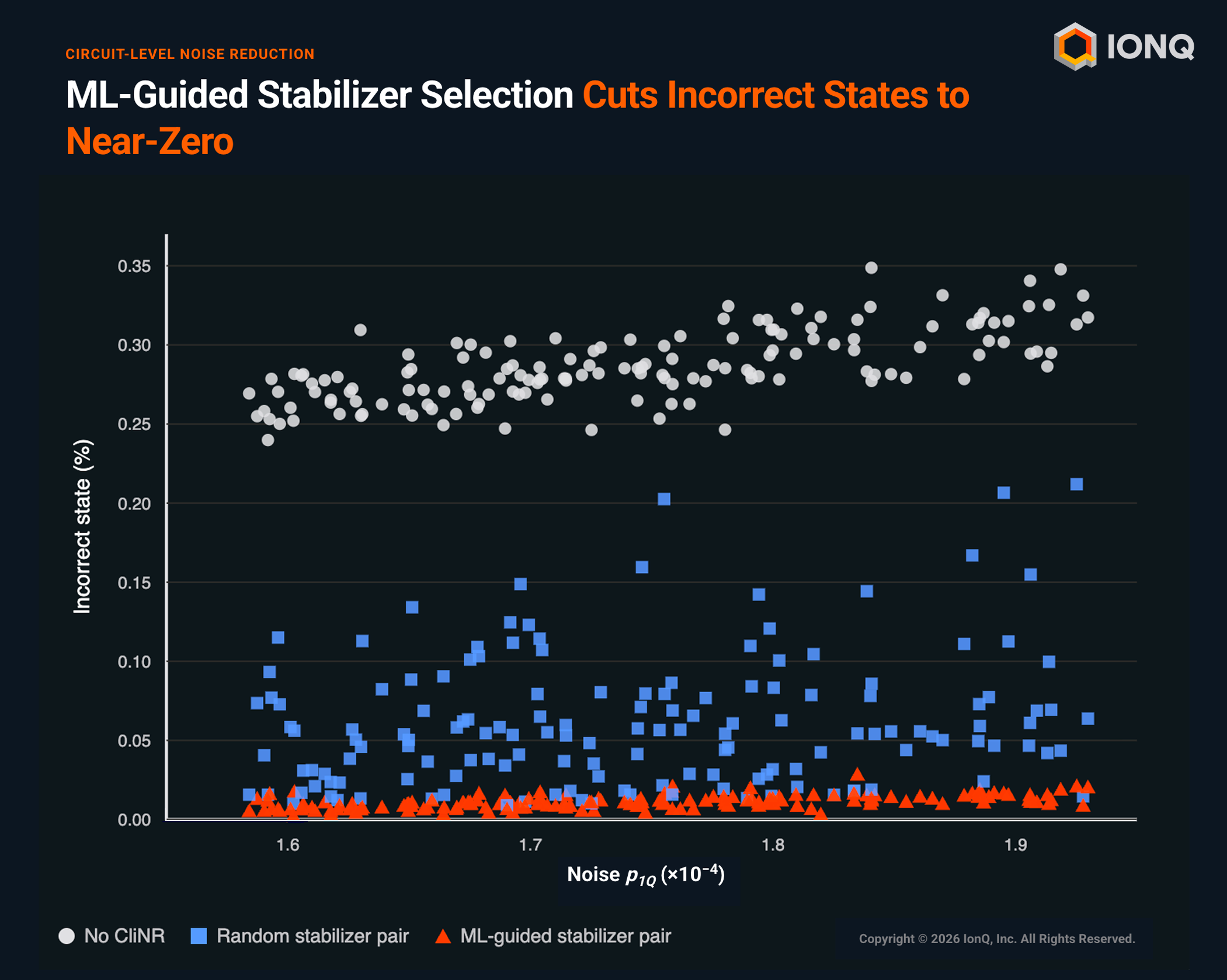
Research results were derived by comparing six quantum circuit stabilizer pairs, with one stabilizer measure mid-circuit and the ancilla readout of the second stabilizer in the pair deferred to the end of the circuit run. Typically, Deep Trotter quantum circuit simulations can require the tracking of many stabilizers, which presents a complex combinatorial problem when choosing which stabilizer pairs to measure. Researchers addressed this problem by implementing a machine-learning model on an NVIDIA GH200 GPU to predict stabilizer quality without running costly simulations. The model was trained on 992 stabilizer pairs per graph forming a data set of 57,536 samples. During inference, it rapidly scored 10^5 candidate stabilizer pairs and selected the highest-scoring pair, outperforming random selection by a wide margin.
Benchmarking Reality: Quantum Advantage in Simulation
Quantifying the Hardware Advantage Gap
An overarching implication of this research is that physical hardware executions using GSE and CliNR protocols conclusively outperform unmitigated, direct physical Trotter circuit runs.
● Hardware vs. Noise Models: Break down the specific behavioral patterns observed when comparing live hardware experiments directly against calibrated noise baselines.
Scalability Paths for Enterprise Chemistry
Molecular systems, whether occurring in the natural world–the FeMoCo enzyme in soil that converts atmospheric nitrogen into ammonia for plants, for example—or created by humans–massive industrial batteries that involve potentially thousands of molecular compounds–are extremely complex. Future innovations will rely on the ability to successfully simulate the nature and interaction of molecules and molecular compounds. Researchers’ successful execution of a 6-qubit encoded Trotter step with assists from GSE and CliNR provide a scalable mathematical blueprint required to ensure the accuracy, efficiency, and reliability of such simulations.
Conclusion: The Blueprint for Application-Native Mitigation
Shifting the Paradigm of Quantum Advantage
In addition to the noise reduction and error detection and mitigation capabilities enabled by this blueprint, the research clearly demonstrates the measurable effect that MCM can provide. It demonstrates that MCM is no longer a luxury architectural feature, but essentially represents the difference between inefficient, post-process error assessments and the ability to dynamically arrest noise before it spreads. In this, it is an absolute baseline requirement for executing meaningful quantum simulations, and one that is inherently supported in IonQ's trapped-ion hardware.
Enterprises that undertake quantum simulations of complex fermionic systems need some assurances that quantum advantage is real, and that quantum computers and algorithms will help them realize competitive and operational advantages that simply cannot be achieved with legacy hardware and methods. Physical hardware capabilities, software-based error mitigation, and custom application compilation all advancing in complete lockstep today can provide these organizations with true commercial Quantum Utility.
Ground Truth Sign-off: To find out more about how GSE and CliNR enabled by MCM can improve complex chemistry and molecular simulations to provide real business benefits, contact IonQ’s Enterprise Solutions team. For more technical details, read the full paper on arXiv: https://arxiv.org/pdf/2605.06792
IonQ Forward-Looking Statements
This blog post contains forward-looking statements. All statements contained in this blog post other than statements of historical fact are forward-looking statements, including statements regarding the anticipated benefits of combining Generalized Superfast Encoding (GSE) and Clifford Noise Reduction (CliNR) enabled by native mid-circuit measurement (MCM); the expected effect of reduced error rates on the accuracy and efficiency of quantum chemistry and fermionic simulations and on the research and development costs and time-to-market of enterprises leveraging them; the scalability of the described approach to larger molecular systems, deeper circuits, and additional qubits; the anticipated capabilities, performance, and availability of IonQ's Tempo-class systems, including support for mid-circuit measurement, qubit reuse, and extended coherence; the potential applications of quantum simulation in drug discovery, materials science, industrial chemistry, and related fields; expectations regarding future quantum error correction and fault-tolerant quantum computing; anticipated growth in demand for fermionic simulations; IonQ's continued collaboration with NVIDIA and qBraid; IonQ's ability to deliver quantum advantage, commercial quantum utility, and competitive or operational benefits to enterprise customers; and IonQ's business strategy, technology roadmap, and future operations.
In some cases, you can identify these statements by forward-looking words such as "advance," "can," "could," "deliver," "enable," "expect," "future," "improve," "may," "offer," "potential," "promote," "provide," "translate," "ultimately," "will," and other similar expressions.
These statements are only predictions based on our expectations and projections about future events as of the date of this blog post and are subject to a number of risks, uncertainties, and assumptions that may prove incorrect, any of which could cause actual results to differ materially from those expressed or implied by such statements, including, among others, those described under the heading "Risk Factors" in our most recent filings with the Securities and Exchange Commission.
New risks emerge from time to time, and it is not possible for our management to predict all risks, nor can management assess the impact of all factors on our business or the extent to which any factor, or combination of factors, may cause actual results to differ materially from those contained in any forward-looking statement we make. Investors are cautioned not to place undue reliance on any such forward-looking statements, which speak only as of the date they are made.
Except as otherwise required by law, we undertake no obligation to update any forward-looking statement, whether as a result of new information, future events, or otherwise.

